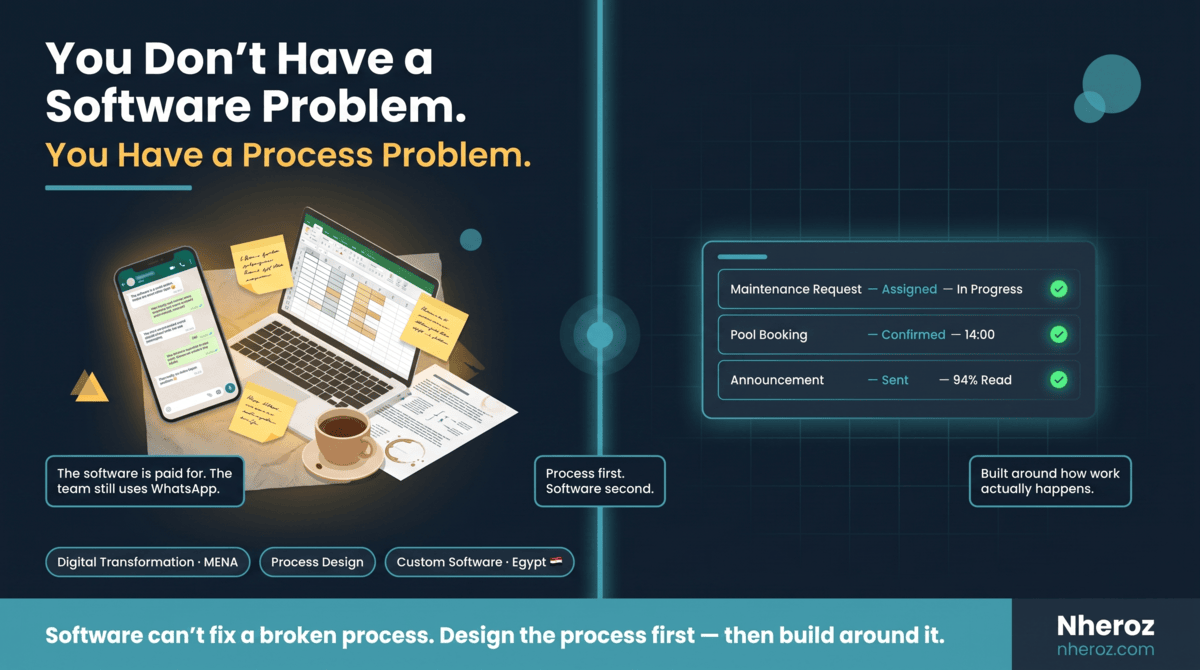
Six months after launch, the software is fully paid for, the team was trained, and the go-live celebration has long faded. But walk the floor today and you'll find half the team still running the same process on WhatsApp and Excel. The system sits open in a browser tab — minimized, mostly ignored. Nobody planned for this. Nobody wanted it. It just happened.
If that scene sounds familiar, I want to offer you a different way to think about what went wrong.
The Software Wasn't the Problem. The Workflow Was.
Most companies approach digital transformation in the same order: feel a pain, search for a solution, buy or build software, and then try to force the team to use it. The process never actually changes — only the tool does.
So the team finds workarounds. Adoption stalls. The software becomes what the industry calls shelfware — something you own but don't use.
Think of it this way: giving a team new software for a broken process is like buying a faster car for a road full of potholes. The bottleneck was never the car. Gartner's 2026 research puts a number on this — 40% of AI and automation projects fail not because the technology doesn't work, but because organizations automated a broken process instead of redesigning it first.
Software should be the output of process design, not the replacement for it.
3 Signs You Have a Process Problem, Not a Software Problem
Sign 1: Your team uses the software and the old method in parallel. If people are logging updates in the system and still sending WhatsApp messages about the same task — the system doesn't match how work actually flows. The real root cause: the process was mapped to how leadership thinks work happens, not how it happens on the ground.
Sign 2: Every "simple" feature request turns into a major rebuild. If adding one new step to a workflow requires months of development, the system was built on a process that was never fully understood to begin with. No process documentation existed before the build. The software was built on assumptions — and assumptions compound over time.
Sign 3: Management uses the system for reporting. Everyone else ignores it. The people doing the actual work find the system adds friction instead of removing it. Only executives log in — to look at dashboards that the frontline team doesn't trust or contribute to. The people who use the system were never consulted in its design.
What Process-First Development Actually Looks Like
When we started working on CammPass — our enterprise compound management platform currently in development — the instinct from every early conversation was the same: "we need an app."
Real estate developers in Egypt build remarkable projects. But once handover happens, the relationship with residents often collapses into improvisation. Maintenance requests go to WhatsApp. Booking shared facilities is a phone call to a guard. Announcements get printed and ignored in the lobby. There's no designed resident experience — it's just reinvented every day by whoever picks up the phone.
The problem wasn't that there was no app. The problem was that there was no process.
So before any design work began, we mapped the experience from the resident's side: How should a maintenance request be raised? Who owns it? How does the resident know it's been resolved? What does "done" actually mean in that context? We asked those questions before opening a code editor.
"CammPass isn't an app for managing compounds. It's an app for giving residents a designed community experience — and that started on a whiteboard, not in a code editor."
The result is a platform where every feature — announcements, community voting, facility booking, payment tracking — is built around a process that was agreed on and validated first. Not bolted onto existing chaos.
Before Building Anything, Do This
- Shadow the process. Spend 2–4 hours watching how the work actually happens today — not how the manual says it should happen. The gap between those two things is where most software projects die.
- Map the gaps. Where does information get lost? Where do people reach for WhatsApp, Excel, or a sticky note instead of the official system?
- Define the ideal flow. Design how the process should work if there were no constraints — then work backwards from that vision to what's buildable now.
- Validate with actual users. Show the process map to the people doing the work, not just the people approving the budget. They will catch things no stakeholder meeting ever will.
- Build software around the validated process. Now you have a spec grounded in reality. Now you can build something people will actually use — because it was designed around how they actually work.
The Real Cost of Getting This Backwards
The most expensive thing a company can build is software for a process nobody has thought through. The second most expensive thing is having to rebuild it 18 months later.
I've seen both. I've been involved in both. That's exactly why Nheroz starts every engagement with process mapping — not wireframes, not a tech stack conversation, not a proposal. A conversation about how the work actually flows today, and what it needs to become.
If you're considering building or upgrading a business system, I'm happy to spend 30 minutes mapping the process with you before we talk about any software. No pitch, no proposal — just a whiteboard session. Book a free strategy session here.
