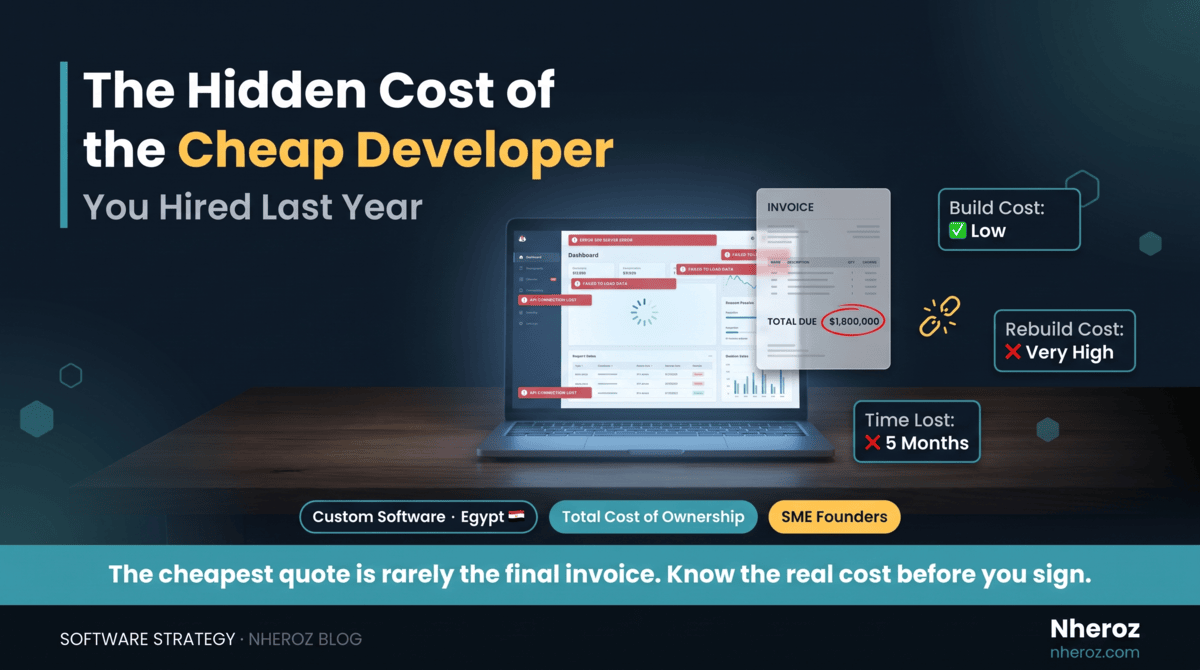
A client came to us not long ago with a codebase they couldn't touch. The developer who built it had disappeared after the final payment. The "affordable" project that cost $3,000 to build was going to cost $15,000 to fix — and that wasn't even counting the seven months of lost revenue while they waited.
I don't tell that story to judge the decision. I tell it because I've watched the same pattern repeat itself more times than I can count. And the reason it keeps happening isn't that CEOs make bad choices — it's that they're using the wrong cost model.
Why the Cheap Option Looks Rational at First
The budget is real. The product isn't proven yet. "Let's start small, validate the idea, and scale later" is not a bad instinct — it's actually sound startup thinking. The problem is how it gets executed.
Freelancer platforms show strong portfolios at low rates. A mid-size agency quote looks five times more expensive by comparison. And there's always a voice in the back of a founder's head saying: "It's just an app. How complicated can it be?"
The problem isn't the choice. The problem is the cost model used to make it. Most founders calculate the build cost. Almost none calculate the total cost of ownership.
The Real Cost Framework: What Never Appears in the Quote
Cost 1: The rebuild. Most cheap builds require partial or full reconstruction within 12–18 months. The code works initially but doesn't scale, isn't documented, and can't be extended without breaking something else. A system built without proper architecture becomes a wall — you can paint it, but you can't move it.
Cost 2: The lost time-to-market. If your product was supposed to launch in month 4 and launched in month 9, calculate what five months of delayed market entry actually cost you. In most cases, it dwarfs the original development budget — and it rarely appears on any invoice.
Cost 3: The team productivity drain. When software doesn't work properly, your operations team works around it — manually. Imagine three staff members spending 1.5 hours a day on manual workarounds. That's 22.5 hours a week, 90 hours a month. What is that worth in salaries and opportunity cost?
Cost 4: The vendor lock-in. Many cheap developers — intentionally or not — make themselves irreplaceable. The code is undocumented, built on unusual frameworks, or structured in a way only they understand. Replacing them is painful. Keeping them is expensive. Both options kill momentum.
Cost 5: The trust cost. If the broken system touches customers, they feel it. Orders fail. Responses are slow. Errors appear. One bad experience costs more in customer lifetime value than the original development budget ever was.
The cheap option isn't cheap. It's a payment plan for a more expensive problem.
What Separates a Development Partner from a Code Vendor
This isn't about price tier. It's about how a developer thinks. Here are five signals that someone will cost you less over time — not just upfront:
- They ask about your business before asking about your budget. A vendor quotes on features. A partner quotes on outcomes. The first question should be about your users, not your wireframes.
- They document as they build. Code without documentation is a liability. Ask any candidate directly: "What does your documentation process look like?" The answer will tell you everything.
- They use standard, maintainable technology. Exotic frameworks look impressive in a portfolio. They become a nightmare when you need to bring in a second developer six months later.
- They build for handover. Even if you plan to work with them indefinitely, a good partner structures the codebase so another developer could pick it up without starting over.
- They price in phases, not just a final delivery. Discovery, build, test, launch, support — each phase should be scoped separately. A single lump-sum quote with no phases is a red flag, not a deal.
The Standard We Hold Ourselves To: VatrinaView
VatrinaView is our live SaaS platform — 50+ paying customers, running on shared infrastructure, at 99.9% uptime. Every technical decision we made while building it came from one question: "What happens when we have 500 customers instead of 50?"
The three-tier image system — thumbnail, regular, zoom — wasn't an afterthought. It was a deliberate architectural decision built around Egyptian internet conditions. We knew our users would be on variable connections, and we built for that reality from day one.
That kind of thinking costs more at the start. It costs nothing by comparison at the scale stage.
We didn't build VatrinaView to impress investors. We built it to survive growth — because rebuilding a live SaaS platform with paying customers isn't an option.
The Two-Year View
| Cost Category | Cheap Developer | Quality Partner |
|---|---|---|
| Initial build | Low | Medium–High |
| Rebuild at 18 months | High | None |
| Time-to-market delay | High | Low |
| Team workaround hours | High | Low |
| Vendor dependency | High | Low |
| Total 2-year cost | Very High | Medium |
If Any of This Sounds Familiar
Most of our best client relationships started with a call that began: "We need help fixing something that went wrong." We never judge that — we've seen it dozens of times. We just wish we'd been involved from the start.
If you're evaluating a software project — new or broken — I offer free 30-minute sessions to give you an honest assessment. No commitment, no pitch. Just a real conversation about what the build actually needs. Book a session here →
