Most founders adopt an agile methodology because someone told them they should. They copy the framework their last employer used, or pick whichever one sounds most familiar — and then wonder why standups feel pointless and nothing ships on time.
The truth is, Scrum, Kanban, and Shape Up are not interchangeable. Each one was built for a different kind of team, a different kind of work, and a different tolerance for structure. Picking the wrong one does not just slow you down — it actively creates friction.
Here is how to actually choose.
What Scrum Gets Right (and Where It Breaks)
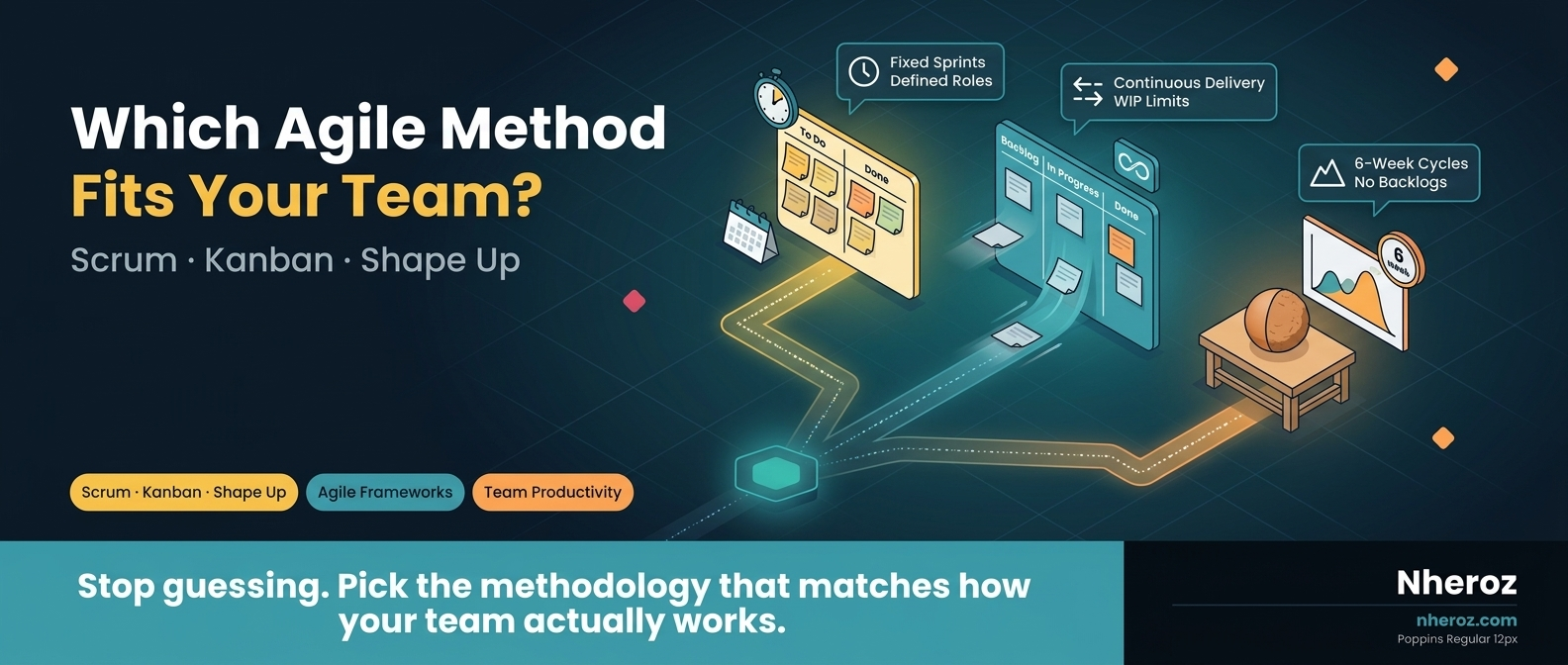
Scrum is the most popular agile framework for a reason. It gives teams a clear heartbeat: two-week sprints, daily standups, sprint reviews, and retrospectives. For product teams building something new, that rhythm creates accountability and predictable delivery.
The ceremonies are not optional — they are the system. Sprint planning forces prioritization. Retrospectives force honest reflection. If your team follows the process, Scrum works.
But Scrum has a hidden cost: overhead. A small team of two or three developers does not need a Scrum Master, backlog grooming sessions, and story point debates every two weeks. The process starts consuming more energy than the product does. Scrum rewards teams large enough to absorb its ceremonies without drowning in them.
Use Scrum if you have a dedicated product owner, a team of four or more, and work that can realistically be scoped into two-week increments.
What Kanban Gets Right (and Where It Breaks)
Kanban does not care about time boxes. It cares about flow. Work items move through columns — To Do, In Progress, Done — and the only rule is limiting how much is in progress at once. That limit is what forces the system to stay healthy.
For support-heavy teams, agencies, or any context where priorities shift daily, Kanban is genuinely excellent. There is no sprint to disrupt when an urgent client request lands. You simply pull it into the queue.
The problem is that Kanban without discipline becomes a graveyard of half-finished work. Without fixed deadlines or sprint commitments, there is no forcing function to close out tasks. Teams that struggle with focus tend to struggle more with Kanban, not less.
Use Kanban if your work is ongoing and unpredictable — maintenance, support, marketing content, or ops — and if your team is self-directed enough to respect WIP limits.
What Shape Up Gets Right (and Where It Breaks)
Shape Up was developed by Basecamp and published as a free book. It rejects sprints entirely and instead works in six-week cycles. Before a cycle begins, a small team — usually one designer and one or two developers — receives a shaped pitch: a problem to solve with defined boundaries but room to figure out the solution themselves.
There are no daily standups in Shape Up. No backlog. No story points. Instead, teams use a hill chart to visualize whether they are still figuring out the problem or already executing toward the solution. It is a fundamentally different mental model.
Shape Up is powerful for product teams that want to ship meaningful features without death-by-meeting. But it requires trust. Founders who need constant visibility into daily progress will feel anxious. And if the shaping work before the cycle is weak, the team goes in blind. The quality of your output in Shape Up is directly proportional to the quality of your input shaping.
Use Shape Up if you are a small, senior product team that wants autonomy, ships features rather than tasks, and can invest real time in defining problems before building starts.
The Real Question: What Kind of Work Do You Actually Have?
The methodology question is really a work-type question. Imagine a team splitting their time between building new features, handling client change requests, and fixing production bugs. No single framework handles all three well.
What if you used Shape Up for new product work, Kanban for support and maintenance, and light Scrum ceremonies — just planning and retros — to keep everyone aligned? Hybrid approaches are not a cop-out. They are often the honest answer.
At Nheroz, working across custom B2B web apps, mobile builds, and GIS platforms, the nature of each project shapes the process — not the other way around. A discovery-heavy enterprise project like compound management software benefits from shaped pitches and defined cycles. A fast-moving e-commerce integration benefits from a Kanban flow that can absorb changing priorities without derailing a sprint.
A Simple Decision Framework
- Team of 4+, building a product, with a dedicated product owner: Start with Scrum.
- Small team, unpredictable work, ongoing delivery: Start with Kanban.
- Senior product team, feature-driven, high trust: Try Shape Up.
- Mixed workload across multiple project types: Build a hybrid intentionally, not accidentally.
The Takeaway
There is no universally correct agile methodology. There is only the one that matches how your team actually works, what you are actually building, and how much process overhead you can absorb without losing momentum.
Start by auditing your current pain points. If standups feel pointless, you may not need fewer meetings — you may need a different framework entirely. If work keeps stacking up unfinished, your WIP discipline is the problem, not your sprint length.
Pick the methodology that removes friction for your specific team, then commit to it long enough to actually learn from it. Most teams abandon frameworks before they have run them correctly even once.