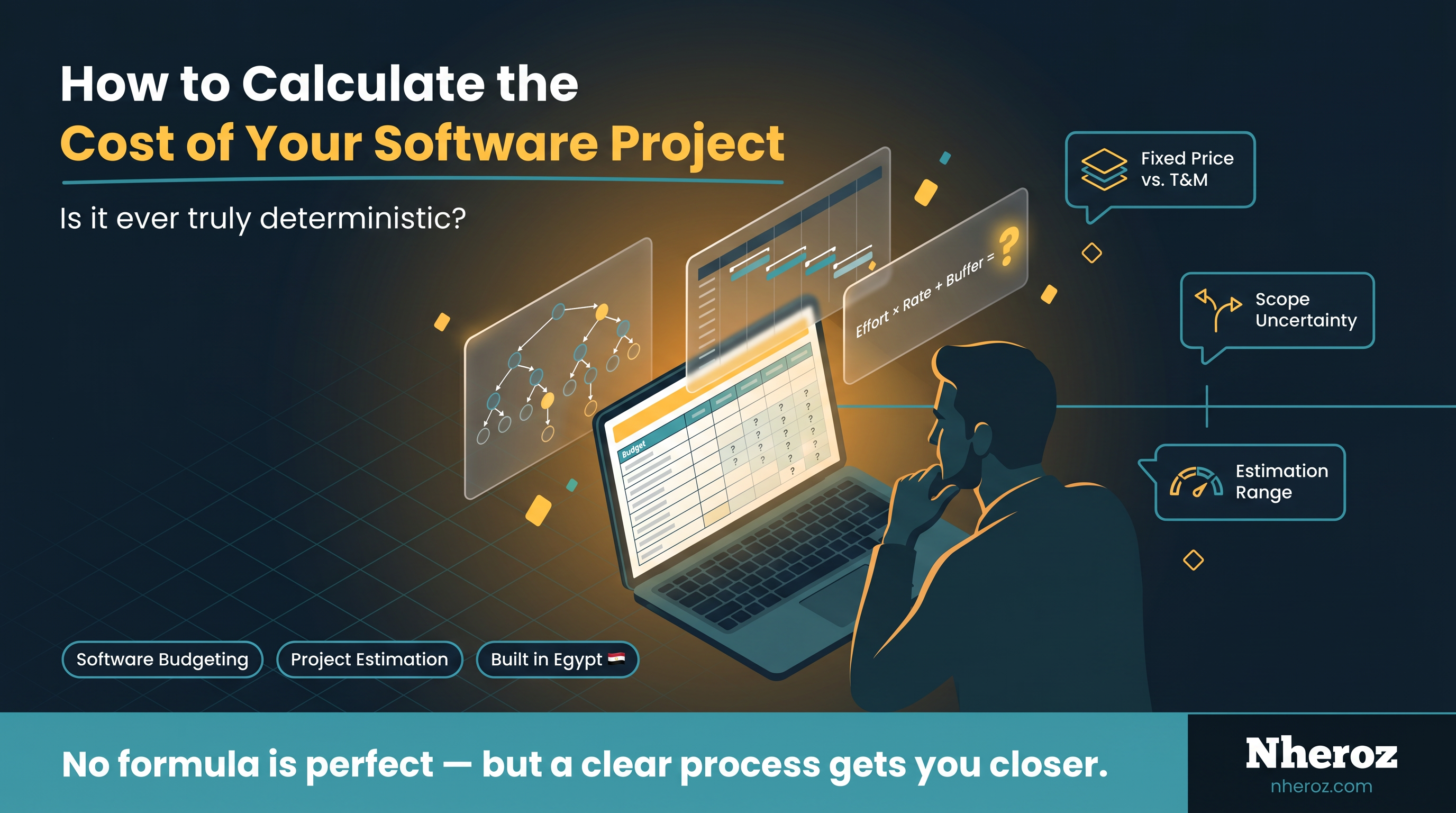
Every founder who has ever asked a development agency for a quote has experienced the same unsettling moment: one vendor says $15,000, another says $80,000, and a third sends a 12-page discovery questionnaire before committing to any number at all. Is someone lying? Is someone incompetent? Or is software pricing genuinely that murky?
The honest answer is: software project cost is not deterministic. It cannot be calculated the way you calculate the cost of printing 500 business cards. But that does not mean it is random — and it does not mean you are helpless.
Why Software Cost Resists a Simple Formula
Physical products have bills of materials. Software has decisions. Every feature hides a cascade of smaller choices — about data models, user flows, edge cases, integrations, and future flexibility. Each choice carries a time cost, and time is what you are really buying.
Scope is the first and most important variable. A "user login" feature sounds atomic, but it can mean email-only authentication, or social login, or SSO, or multi-factor authentication, or all four. The words on a feature list almost never capture the full surface area of what needs to be built.
The gap between what a founder imagines and what an engineer has to build is where most budgets quietly collapse.
The Variables That Actually Drive Your Number
Once you accept that cost is a function of variables rather than a fixed price, you can start reasoning about each variable clearly. Here are the ones that move the needle most.
- Scope clarity: The more precisely you can describe what the software must do — and what it must not do — the more accurate any estimate becomes. Wireframes and user stories compress uncertainty faster than written descriptions alone.
- Tech stack and integrations: Building on proven, well-documented technology costs less than pioneering custom solutions. Every third-party API or payment gateway you integrate adds negotiation time, documentation time, and testing time.
- Team location and seniority: A senior developer in Cairo costs differently than a senior developer in Berlin or San Francisco. Neither is inherently better — but the rate difference is real, and so is the impact on your total.
- Timeline compression: Rushing a project does not halve your cost. It often increases it. Parallelizing work across more developers introduces coordination overhead and integration complexity.
- Post-launch obligations: Does the budget include bug fixes after go-live? Hosting setup? A month of support? These are often quoted separately and can add 15–25% to your initial build cost if not discussed upfront.
A Practical Framework for Estimating Before You Have a Quote
You do not need to wait for a vendor to give you a number before you start thinking about budget. A rough internal estimate built on honest inputs is more useful than a polished quote built on shaky assumptions.
- List your features and tag each as MVP or nice-to-have. The MVP list is what you are pricing. Everything else is a future conversation.
- Estimate complexity per feature: simple, medium, or complex. A simple feature might take one to two days. A complex one might take two to three weeks. Assign rough days to each.
- Multiply total days by a daily rate. Research prevailing rates in your target market. For Egyptian software teams, blended daily rates for senior full-stack work typically range from $200 to $500 depending on seniority and agency structure.
- Add a 20–30% contingency buffer. Not because your estimate is wrong — because unknown unknowns are a structural feature of software, not a failure of planning.
- Separate infrastructure and licensing costs. Cloud hosting, domain registration, third-party services, and API subscriptions are recurring costs that sit outside the development budget entirely.
What a Good Vendor Quote Actually Tells You
A vendor who gives you a number instantly — without asking questions — is giving you a marketing number, not a real estimate. A vendor who asks detailed questions before quoting is doing the right thing, even if it feels slow.
The most reliable quotes come attached to a scope document. If a vendor can show you the list of features and assumptions that generated their number, you can have a real conversation. If they cannot, you are comparing apples to guesses.
Scope changes after a project starts are the single most common reason software budgets double. Pin the scope. Protect the budget.
Is There Ever a Fixed Price?
Yes — but it requires fixed scope. Fixed-price contracts work when every feature is documented, every integration is understood, and both sides have agreed on what done means. They are rare for the first version of a new product because founders almost always learn something during build that changes what they want.
A time-and-materials model gives you flexibility but requires discipline. A phased fixed-price model — where each phase is scoped tightly before pricing — is often the most balanced approach for complex B2B software.
Software cost estimation is not a math problem. It is an information problem. The more clarity you bring into the conversation — about what you need, what you can defer, and what success looks like — the tighter and more trustworthy your estimates become. Start there before you start comparing quotes.
